What to Look for in a Custom Home Builder
Key factors to consider when choosing a custom home builder. Ensure your dream home becomes a reality with expert guidance from Lemmon Homes.
6 min read
%20-%202026-10-05T150804.728.png)
Building a custom home involves hundreds of decisions, months of coordination, and many moving parts that homeowners do not see from day to day. That makes communication with your home builder one of the most important parts of the experience.
Good communication is not simply getting a quick response every time you have a question. It means knowing what is happening, understanding what comes next, hearing about decisions before they become urgent, and getting a clear explanation when something affects your budget, selections, or schedule. It also means your builder is willing to have straightforward conversations when the answer is not necessarily the one you hoped to hear.
At Lemmon Homes, the custom home building process is organized into ten stages, from the initial conversation through design, pricing, selections, construction, and move-in. That structure helps give important conversations a place in the process rather than leaving homeowners to figure out when they should be asking questions.
So, what should good communication with your home builder actually look like?
Some of the most important communication happens long before excavation begins.
Early conversations should establish more than the size, style, and features of the home. This is also the time to talk through budget expectations, the homesite, design priorities, financing, selections, responsibilities, and the decisions that will need to be made before construction.
A homeowner should not have to guess where they are in the process or what is expected of them next.
Lemmon Homes organizes a build into ten stages: Discovery, Design & Pricing, Financing, Purchase Agreement, Homesite Inspection, Design Center, Pre-Construction Meeting, Loan Closing, Construction, and Move-In. For homeowners who want a closer look at how those stages fit together, Lemmon Homes explains what actually happens during each phase of a custom home build.
That structure matters because many construction problems that appear to be communication problems actually begin as expectation problems. If the scope, budget, responsibilities, or decision-making process was never clearly discussed, confusion later in the build becomes much more likely.
A good builder does more than tell you what is happening. A good builder helps you understand why it matters.
Suppose a homesite inspection identifies a condition that could affect excavation. Simply telling a homeowner that site work may cost more is not particularly helpful. Better communication explains what was found, why it matters, what can be determined now, what may remain uncertain until excavation, and what the possible next steps are.
The same principle applies throughout a custom home build. When a floor plan adjustment affects structural requirements, a selection affects the budget, or a construction condition affects the schedule, homeowners need context rather than construction terminology alone.
This becomes particularly important when the answer involves uncertainty. A builder cannot control the weather or guarantee what is beneath the ground before excavation begins. Good communication does not mean promising that those uncertainties will never affect the project. It means explaining what is known, what is not yet known, and what happens if conditions change.
That kind of clarity gives homeowners useful information without creating unrealistic expectations.
There is a difference between frequent communication and useful communication. A homeowner does not necessarily need a message every time something happens on the jobsite. What matters is receiving information at the points when it helps them understand progress, prepare for what comes next, or make a decision.
Consider a Northeast Ohio project where winter weather prevents a planned foundation pour. A vague update might simply say that construction has been delayed. A useful update would explain why conditions are not appropriate for the planned work, what needs to happen before work can proceed, whether another part of the project can move forward in the meantime, and whether the overall schedule is likely to be affected.
The same is true when an unexpected condition is uncovered during excavation. Homeowners should not be left wondering what happened or trying to interpret a surprise cost without context. They should understand the condition, the available options, and what those options could mean for the project.
Good communication is proactive because it gives you information when that information can still help you.
One of the easiest ways to create frustration during a custom home build is to treat the schedule as if it can never change.
Lemmon Homes notes that a custom home takes approximately 8 to 12 months on average from start to finish, but the timing of an individual project can vary. Weather, permitting and inspections, site conditions, material availability, selections, and changes can all affect how construction progresses.
For homeowners in Northeast Ohio, weather is not an abstract consideration. Rain, freezing conditions, snow, and temperature swings can affect certain phases of construction. Permitting and inspections can also introduce dependencies that are not entirely within a builder’s control.
A good builder should be willing to explain those dependencies rather than offer a date without context. Homeowners who want a more detailed look at the variables involved can read how long it really takes to build a custom home in Ohio.
The goal is not to eliminate every schedule change. It is to make sure a change does not become an unexplained surprise.
Homeowners make some of their biggest decisions well before those choices appear physically in the home.
At Lemmon Homes, much of that decision-making occurs during Design & Pricing and the Design Center stage. Those decisions establish both major elements of the home and many of its interior and exterior finishes. As outlined in Lemmon Homes’ custom home building process, changes made after those points can become change orders that affect cost and time.
That is why good communication around selections should answer three simple questions:
What do I need to decide? When do I need to decide it? What happens if I change it later?
Those answers help prevent decision-making from feeling like a series of emergencies. They also give homeowners a better opportunity to think about priorities while there is still time to evaluate the options.
Communication at this stage should help you make informed decisions, not pressure you into making fast ones because a deadline was never explained.
%20-%202026-10-05T150939.158.png?width=1280&height=720&name=Featured%20Image%20Size%20(1280%20x%20720%20px)%20-%202026-10-05T150939.158.png) Change Orders Should Never Feel Like a Surprise
Change Orders Should Never Feel Like a SurpriseChanges can happen during a custom home build. A homeowner may decide to upgrade a finish, adjust a feature, or request something that was not included in the original scope. A site or construction condition may also require a different approach.
The important question is how those changes are communicated.
Before approving a change, homeowners should understand what is changing and how it may affect the project. Written documentation is especially important because construction decisions can have consequences for multiple trades, materials, costs, and scheduling.
As part of Lemmon Homes’ building process, the Purchase Agreement establishes important project details before construction, including the scope, specifications, price, payment schedule, and timeline. Decisions that alter the established project later may become change orders.
Documenting those changes helps make sure the homeowner and builder are working from the same expectations rather than relying on a conversation that could be remembered differently weeks later.
Building a custom home is collaborative, which means the homeowner has responsibilities in the communication process too.
Your builder needs decisions when they are due. Your lender may need documents or responses. Scheduled walkthroughs require your participation. If you are considering a change, bringing it up early gives the team more opportunity to explain the implications before work has progressed further.
Within Lemmon Homes’ custom home building process, the builder handles areas such as drawings, permitting, scheduling, trades, inspections, and site management, while homeowners remain involved in lender communication, scheduled decisions, and walkthroughs. During construction, Lemmon’s project managers and craftsmen build the home with regular updates and walkthroughs incorporated into the process.
For a broader picture of how that relationship develops beyond communication alone, Lemmon Homes also explains what it’s like to work with a custom home builder from first meeting to move-in.
The better both sides understand their responsibilities, the easier it is to keep decisions moving without unnecessary confusion.
One of the most valuable things a custom home builder can tell you is that an idea needs to be reconsidered.
Perhaps a design change has structural implications. A particular selection may push the budget beyond the range you established. A requested change may create a significant schedule impact. Or the characteristics of the homesite may make one solution less practical than another.
A builder who simply agrees with every request is not necessarily communicating well. An experienced builder should be willing to explain the tradeoffs and help you understand the consequences of a decision. You may still choose to proceed, but you should be able to do so with a clearer understanding of what that choice means for your home.
Good communication is not about telling homeowners what they want to hear. It is about giving them the information they need to make confident decisions.
You should not need construction expertise to understand what is happening with your home.
Good builder communication should leave you with a clear sense of where the project stands, what comes next, whether you need to make a decision, and whether anything has changed that could affect the scope, budget, or schedule.
That does not mean there will never be uncertainty. Custom homes are built on real properties, in real weather, through a process involving designers, lenders, trades, inspectors, suppliers, and homeowners. Some variables only become clear as the project moves forward.
The difference is how those moments are handled.
The National Association of Home Builders has similarly emphasized the importance of proactive homeowner education and clear expectations, particularly around budgets, allowances, schedules, decisions, and change orders. When homeowners understand how the process works before an issue arises, normal construction variables are less likely to feel like unexplained problems.
When expectations are established early, important decisions are discussed before they become urgent, and changes are explained with context, homeowners can spend less time wondering what is happening and more time participating meaningfully in the process.
Building a custom home is a significant personal and financial decision. You should feel comfortable asking questions and understand the answers you receive.
At Lemmon Homes, the process is designed to move homeowners through defined stages from the first conversation through design, pricing, selections, construction, and move-in. During construction, that includes project oversight, regular updates, and walkthroughs as the home progresses.
If you are considering building a custom home in North Canton, the greater Akron-Canton area, or elsewhere in Northeast Ohio, you do not need to have every answer before you begin. A conversation about your goals, budget, homesite, and priorities can help clarify what comes next. Schedule a custom home consultation with Lemmon Homes.
%20-%202026-05-05T153241.366.png)
Key factors to consider when choosing a custom home builder. Ensure your dream home becomes a reality with expert guidance from Lemmon Homes.
%20-%202026-09-14T151403.698.png)
Learn why Northeast Ohio is an ideal place for custom home building, offering flexibility, community options, and thoughtful design for your future.
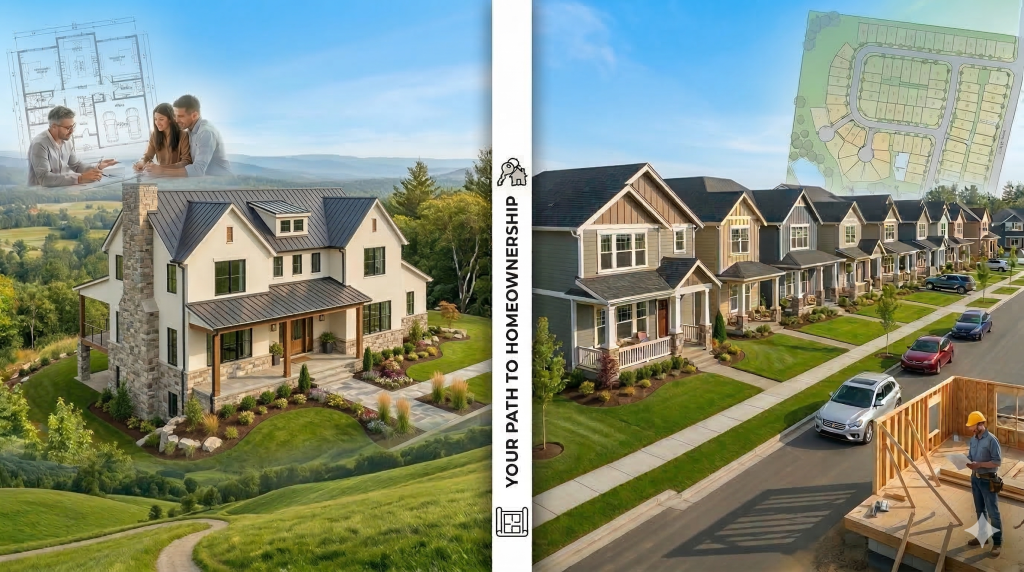
The key differences between custom and production homes to make an informed choice that aligns with your lifestyle, budget, and vision.